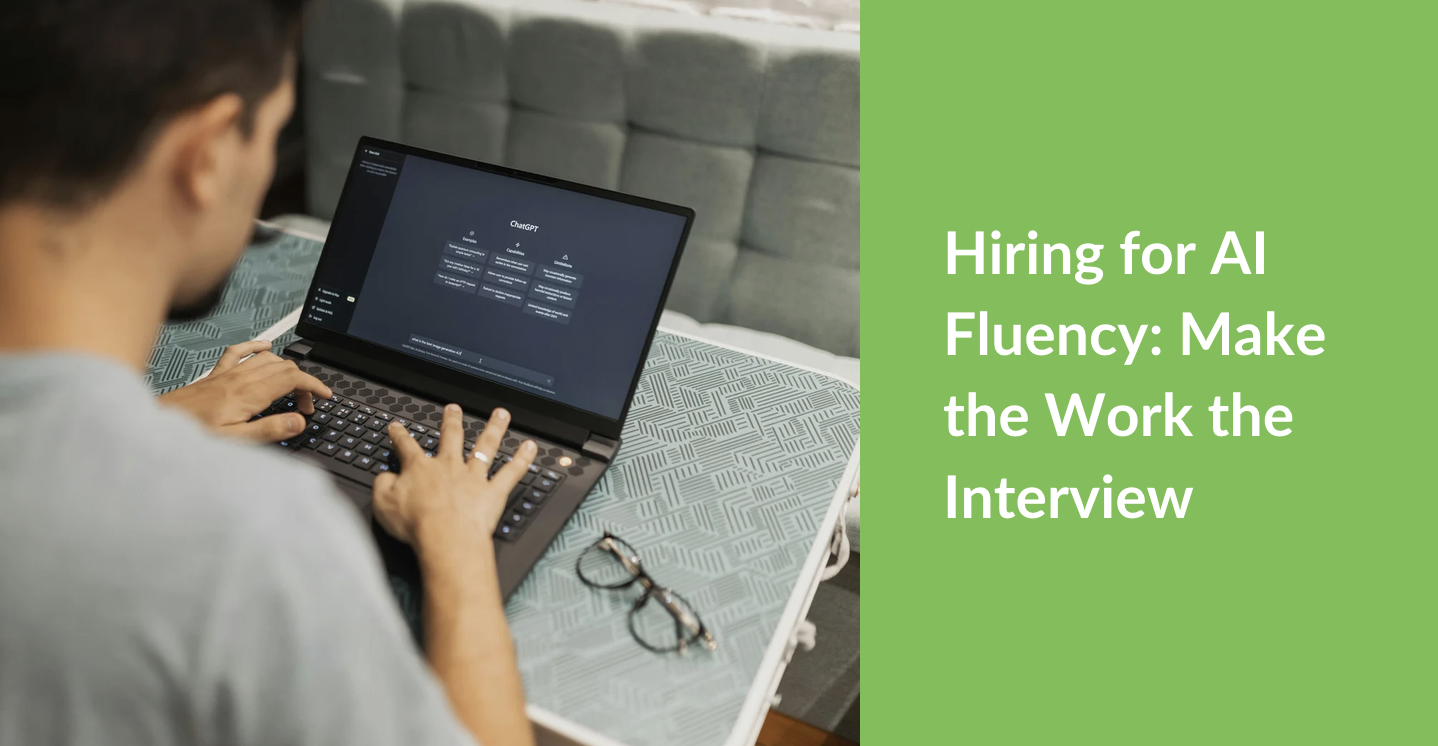
Hiring for AI Fluency: Make the Work the Interview
If you run early-career hiring, you've probably been handed the same instruction talent leaders keep describing to us, “go hire AI-fluent talent.” One huge problem: almost no one gives you a definition of what AI fluency is or a reliable way to spot it in a candidate.
Veris Insights has done the clearest thinking available on the first half of that problem, and their work is worth reading in full. Their argument is that AI fluency has very little to do with whether someone can operate a particular tool–these tools get easier by the month, and before long every candidate will show up able to use them. What separates one early-career hire from another is judgment:
- knowing when AI belongs in the work and when it doesn't,
- directing it toward a useful result,
- reading its output critically instead of trusting it on faith,
- and owning whatever comes out the other side.
Judgment doesn't show up on a resume
This is tricky, because like many skills, judgment isn't visible on a resume. Nor does it surface in a standard 30-minute interview, where a candidate can describe how they'd use AI without actually demonstrating it.
The companies furthest ahead have reached the same conclusion, and Veris documents several of them. They've stopped asking candidates about AI and started watching candidates work with it. They run live exercises built around messy, realistic tasks, and they hand over flawed AI output to see who catches the problem. IBM went as far as redesigning its entry-level roles around this and expanding its early-career hiring rather than cutting it, on the logic that you don't get future judgment by skipping the people who develop it.
You don't have to build the assessment yourself
All of that points to one practical recommendation: if you want to assess AI fluency, design a project and watch candidates complete it. But scoping a meaningful project, sourcing candidates worth assessing, setting it up so it's fair and comparable across people, running it, paying everyone for their time, and reviewing the results is real work. It's a hiring process stacked on top of the hiring process you already don't have time for.
That gap is the reason Parker Dewey exists. For more than ten years, Parker Dewey has run paid, project-based assessments for companies hiring early-career talent. A candidate completes a defined piece of actual work, you see how they handle it, and you make a better-informed decision than any resume or interview would support. Parker Dewey calls it “making the work the interview.” When the thing you're trying to evaluate is judgment, the only honest way to measure it is to give someone real work and watch the judgment show up.
You don't have to build any of this from scratch! Tell Parker Dewey about one early-career role you're hiring for, and the team will help you turn it into a project designed to surface exactly the judgment Veris is describing, without adding to your workload. And for a limited time, eligible employers can pilot project-based assessments for AI skills at no cost, thanks to IBM SkillsBuild.
Start with one role. [Build your first project →]
(One last note: the clearest articulation of what AI fluency means came from Veris Insights, not from Parker Dewey, and they deserve the credit for framing it so well. Parker Dewey has just spent a decade building the way to measure it.)